
Property Division Attorney in Austin, Texas
Navigating property division during a Texas divorce demands more than just legal knowledge — it requires combined experience and sharp instinct. Having worked through high-asset divorces and complex property litigation in Austin, I’ve seen how marital assets, from retirement accounts to business interests, can become flashpoints. Without a skilled attorney who understands both community property laws and the just and right division standard, your post-divorce financial stability is genuinely at risk.
The characterization of community property versus separate property is where most property division disputes begin. A knowledgeable Austin property division lawyer will examine financial records, deeds, titles, and pension plans to establish what qualifies under Texas Family Code Chapter 3. Whether assets include a family home, jointly owned real estate, or retirement accounts funded before the date of marriage, each requires careful valuation — and the burden of proving separate property rests on the spouse claiming it through clear and convincing evidence.
What many divorcing spouses underestimate is the complicated intersection of equitable division with fault, earning capacity, age, health, and the needs of minor children. Texas courts apply discretion — not a mechanical 50/50 formula — guided by Texas Family Code Section 7.001. Representing both high-net-worth individuals and stay-at-home parents, I’ve found that representation rooted in determination and empathy consistently produces a more fair and balanced distribution of the marital estate than rigid formulas ever could.
Get a Free Consultation
Acting now means taking the first step towards resolving your case quickly. Let’s tackle your legal challenges together — sooner rather than later.
Home » Family Law » Property Division
—
How Property is Divided in Texas?
Understanding community property laws means recognizing that assets acquired during marriage carry equal ownership interest for both spouses — but equitable distribution rarely follows mathematical formulas. Courts evaluate length of marriage, earning capacity, contributions, health, and fault in breakup of marriage before reaching a just and right outcome. Unlike a rigid 50/50 split, judges weigh financial and non-financial contributions, marital misconduct, and each party’s future financial needs to reach fair division.

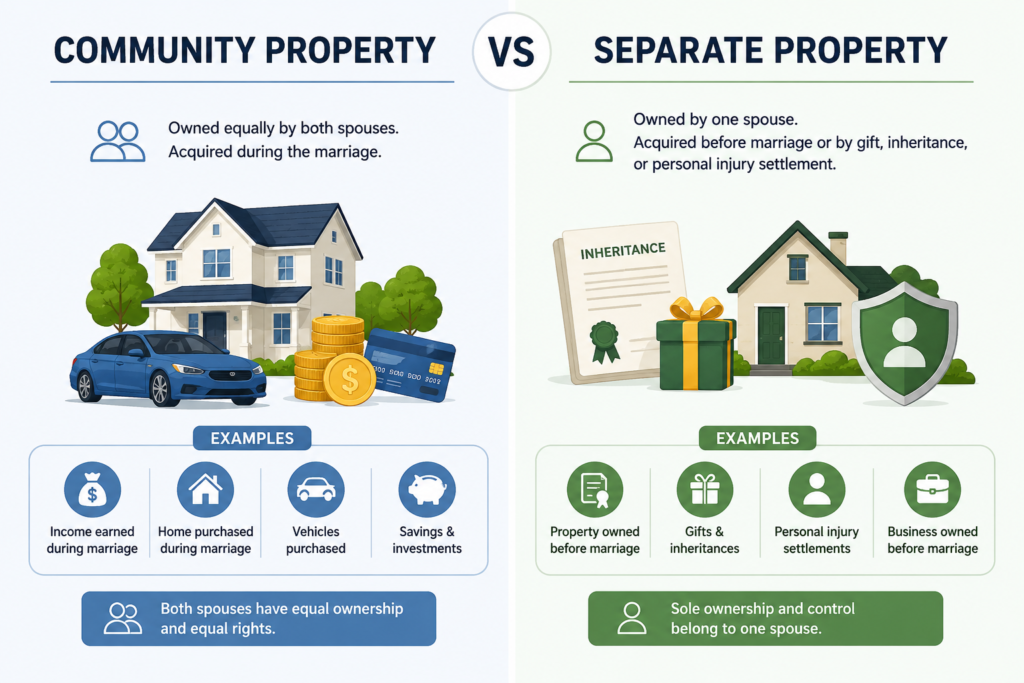
Prenuptial agreements remain the clearest mechanism for defining which belongings before marriage stay protected, yet courts also weigh factors like whether income from separate property was reinvested jointly. Marital misconduct, appreciation of separate property, and whether someone used personal funds to improve a house all influence outcomes. Texas treats community property with a presumption toward equal division — but equitable doesn’t always mean identical. Understanding the classification boundary before disputes arise is what separates financially prepared spouses from those rebuilding after settlement.
Community Property vs Separate Property
In Texas, community property laws establish joint ownership between spouses over assets acquired during marriage. Every dollar earned — from wages, salary, or investments — carries an equal ownership interest unless specifically documented otherwise. Many couples operate like a financial partnership, assuming both contribute equally to shared wealth. What surprises most people, however, is how quietly separate funds can lose their protected status when commingled with marital funds — a distinction that becomes financially devastating without proper legal guidance.
Classification of assets rarely follows common assumptions. Belongings before marriage, family heirlooms, inheritance, and certain gifts retain separate status — but only if never convert to marital property through shared accounts or joint titling. I’ve seen individual retirement accounts funded entirely before a relationship begin losing separate identity simply because marital funds were deposited alongside them. The line between equitable treatment and equal division often hinges on documentation that most people never think to preserve until a divorce forces the conversation.
● Community property — most assets acquired during marriage
● Separate property — assets owned before marriage
● Gifts and inheritances — typically separate property
● Personal injury compensation — may be separate
●Business interests acquired during marriage
● Retirement and pension accounts (marital portion)
●Debts accumulated during marriage
Schedule Your Free Consultation
Fill out the form below and our attorneys will contact you within 24 hours.
Confidential or time-sensitive information should not be sent through this form.
FREQUENTLY ASKED QUESTIONS
Common Questions About Property Division
Is Texas a 50/50 divorce state?
Texas is a community property state but division is not automatically 50/50. Courts divide marital property in a manner that is just and right considering factors such as each spouse’s earning capacity, fault in the breakup of the marriage, the nature of the assets, and the needs of the children.
What is considered separate property in Texas?
Separate property in Texas includes assets owned before marriage, gifts received by one spouse, inheritances, and personal injury compensation for pain and suffering. Separate property is not subject to division in divorce. However it must be clearly traced and documented — without proper documentation assets may be presumed to be community property.
How are retirement accounts divided in Texas divorce?
Retirement accounts accumulated during marriage are community property subject to division. To divide certain retirement accounts like 401(k)s and pensions a Qualified Domestic Relations Order (QDRO) is required. This is a specialized legal document that must be drafted carefully. Our attorneys have extensive experience handling retirement account division.
What happens to the family home in a Texas divorce?
The family home is typically community property. Options include selling the home and dividing proceeds, one spouse buying out the other’s interest and refinancing, or temporarily postponing sale until children are grown. Our attorneys help evaluate each option and negotiate the best outcome based on your specific circumstances.
How does adultery affect property division in Texas?
Texas is a fault divorce state and marital fault including adultery or cruelty can influence how the court divides community property. A judge may award a disproportionate share of community property to the innocent spouse as compensation for the other’s fault. The impact depends on the specific circumstances of each case.
Can a spouse hide assets during Texas divorce?
Hiding assets during divorce is illegal. Texas courts have broad discovery powers to uncover hidden assets including subpoenas, depositions, financial records requests, and forensic accounting. If a spouse is caught hiding assets the court may award a greater share of the marital estate to the other spouse as a penalty.