
Paternity Attorney in Austin, Texas
Paternity cases in Texas cut deeper than most family law matters — they reshape legal obligations, redefine parental rights, and determine how a child experiences stability for years ahead. In my experience working family law matters across Central Texas, I’ve seen how unresolved parentage questions create cascading damage — financially, emotionally, and legally. Whether you’re a mother seeking child support or a father striving to establish meaningful relationships with your child, the Texas Family Code, including §151.001, governs what each parent owes and what each minor deserves in terms of education, finances, and resources for survival.
What many families overlook is that paternity isn’t just a biological question — it’s a legal determination that affects estate rights, medical coverage, emotional stability, and financial support for a child born into any marital or non-marital relationship. A SAPCR — Suit Affecting Parent-Child Relationship — is often the vehicle through which courts resolve paternity disputes and legally established fatherhood. With 50 years combined experience among our lawyers, our firm has guided single parents, unmarried men and women, and divorced families through the most sensitive matters in Texas paternity laws — always keeping the best interests of the child front and live in every legal proceeding.
Get a Free Consultation
Acting now means taking the first step towards resolving your case quickly. Let’s tackle your legal challenges together — sooner rather than later.
Home » Family Law » Paternity
—
What is Paternity in Texas?
In Texas, paternity refers to the legal determination of a father-child relationship — distinct from biological fact alone. Under Texas Family Code §151.001, legally established fatherhood grants a minor access to financial support, medical, and educational resources for survival. Whether born out of wedlock or within a marital relationship, parentage shapes custody, visitation, and parental rights for both men and women navigating family law.

When parents disagree or circumstances remain indeterminate, court-ordered paternity through DNA testing becomes the appropriate path. The alleged father or a governmental agency may file petitions with the court, triggering genetic testing under Tex. Fam. Code §160.505. The process is painless — a simple cheek swab — yet highly accurate at 99% accuracy, with paternity test results returned within 4-6 weeks. Once paternity confirmed, the court issues orders covering custody, visitation, and child support, including potential retroactive support and prenatal or neonatal care costs under §160.636.
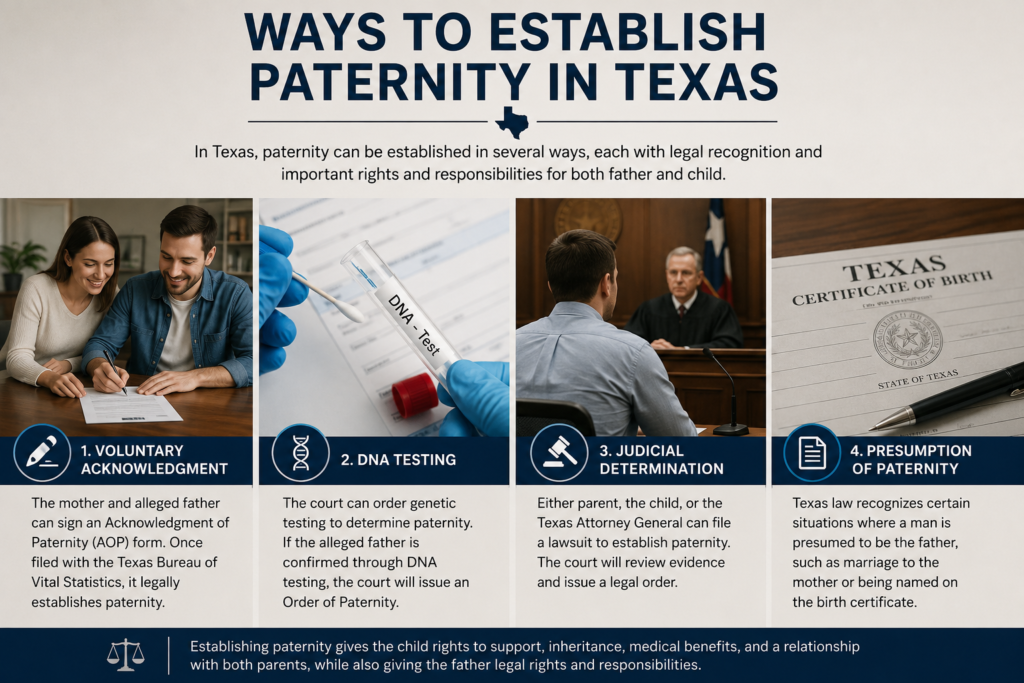
Ways to Establish Paternity in Texas
Paternity establishment in Texas isn’t a single-track process — it branches depending on the circumstances surrounding the child’s birth and the parents’ relationship. Through 35 years of family law practice, one pattern becomes clear: the earlier paternity is legally established, the stronger the parent-child relationship becomes. Texas recognizes three primary mechanisms, each governed by the Texas Family Code, and each carrying distinct legal obligations for both mother and father. Whether married or born out of wedlock, every child deserves a legally recognized father who can provide financial support and stability.
The Voluntary Acknowledgment of Paternity — commonly called the AOP — is the most straightforward method when parents agree. Both parties sign the AOP form at the hospital when the child is born, or later through the Texas Vital Statistics Unit. Signing carries the weight of penalty of perjury, making the male signatory the legal father with full rights and duties as a parent. When a presumed father exists — such as an ex-husband within 300 days of divorce — a corresponding Denial of Paternity (DOP) must accompany the AOP to properly reassign parentage.
● Acknowledgment of Paternity (AOP) — signed by both parents
● Court-ordered DNA testing
● Presumption of paternity for married couples
● Administrative paternity order through Texas AG
● Voluntary paternity establishment at birth
● Genetic testing through accredited laboratory
● Adjudication of paternity through family court
Establish Your Parental Rights — Free Consultation
Fill out the form below and our attorneys will contact you within 24 hours.
Confidential or time-sensitive information should not be sent through this form.
FREQUENTLY ASKED QUESTIONS
Common Questions About Property Division
Why is establishing paternity important in Texas?
Establishing paternity benefits everyone involved. For children it provides access to financial support from both parents, health insurance, inheritance rights, Social Security benefits, and knowledge of their medical history. For fathers it creates legal rights to seek custody and visitation. For mothers it ensures the father can be held responsible for child support.
How is paternity established in Texas?
Paternity can be established in Texas through an Acknowledgment of Paternity signed by both parents, a court order after DNA testing, or through administrative proceedings with the Texas Attorney General’s Office. When parents are married at the time of birth the husband is presumed to be the legal father.
Can a father deny paternity in Texas?
Yes. If a man believes he is not the biological father he can contest paternity. This typically involves requesting a court-ordered DNA test. If DNA testing confirms he is not the biological father the court can terminate the legal father-child relationship. There are time limits for contesting paternity so it is important to act promptly.
What rights does an unmarried father have in Texas?
An unmarried father in Texas has no automatic legal rights to custody or visitation until paternity is legally established. Once established he can seek a court order for custody, visitation, and parenting time. Establishing paternity also creates the obligation to pay child support.
Can paternity be established if the alleged father refuses testing?
Yes. If an alleged father refuses voluntary DNA testing the court can order testing. Refusal to comply with a court-ordered paternity test can result in the court drawing an adverse inference — meaning the court may presume the man is the father based on his refusal to cooperate.
How long does a paternity case take in Texas?
Uncontested paternity cases established through an Acknowledgment of Paternity can be completed quickly. Contested paternity cases requiring DNA testing and court proceedings typically take several months. The timeline depends on the complexity of the case and court schedules in Travis County.