
DWI Defense Attorney in Austin, Texas
Anyone arrested for drunk driving in Travis County quickly discovers that the criminal justice system moves on its own clock. Travis County District Attorney’s Office handles felony DWI, while Travis County Attorney’s Office prosecutes misdemeanor DWI, and under José Garza the office has been cracking down on first-time offenders as aggressively as repeat ones. Someone facing a first offense is often stunned to be fingerprinted, photographed, and treated like criminals before even speaking with a defense attorney. That shock is exactly why jail release and early counsel matter so much.
A Class B misdemeanor first conviction can balloon into a Class A misdemeanor on a second offense, and a third offense turns into felony territory carrying far severe penalties. Add DWI with a child passenger or intoxication assault to the facts and the stakes climb sharply, threatening real jail time, steep fines, court-ordered community service, Texas DPS surcharges, probation, driver’s license suspension, and an increased insurance premium on every car insurance policy for years afterward. Anyone accused deserves a lawyer focused on protecting rights and freedom, not just paperwork.
Many clients call after searching for a former prosecutor who brings unique insight into DWI proceedings, someone who understands how employment difficulty follows a conviction long after the courtroom closes. Effective representation means a proactive defense strategy built around ordinary citizens who never lost normal use of their mental faculties or physical faculties, when officers claimed otherwise. An aggressive DWI lawyer treats every file as if the client was never legitimately intoxicated behind the wheel, drafting a custom Action Plan with update emails so nothing about the case feels uncertain.
Get a Free Consultation
Acting now means taking the first step towards resolving your case quickly. Let’s tackle your legal challenges together — sooner rather than later.
Home » Criminal Defense » DWI Defense
—
DWI Charge in Texas
A DWI charge in Texas carries consequences far beyond a single night’s criminal offense — your driver’s license, freedom, and financial future all hang in the balance simultaneously. Texas law defines intoxicated as either a BAC of 0.08 or higher, or loss of normal use of mental or physical faculties due to alcohol or drugs. From the moment of arrest, two separate legal clocks begin ticking at once.
A third DWI offense crosses into felony territory — specifically a third-degree felony — where prison sentences range from two to ten years in TDCJ, not county jail time. The fine ceiling reaches $10,000, and license suspension can extend up to two years. Beyond the direct punishments, a felony conviction permanently affects employment background checks, CDL eligibility, and firearm ownership. Aggravating factors like a child passenger under 15 or intoxication assault push the case even further into felony classifications handled directly by the Travis County District Attorney’s Office.
Texas DWI Penalties
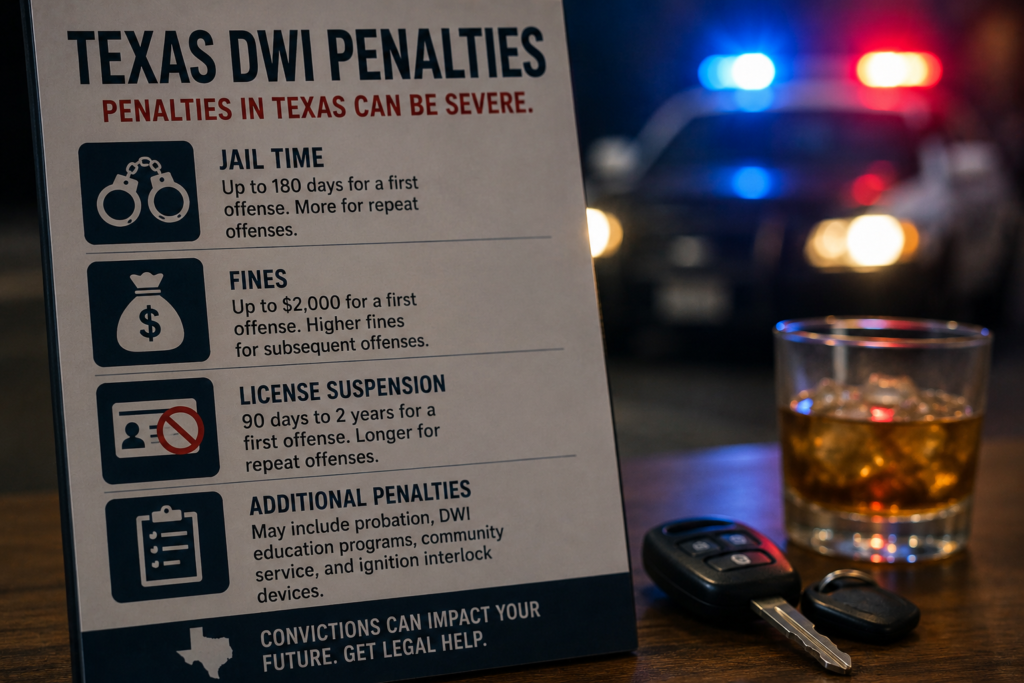
Texas doesn’t offer much grace when it comes to DWI convictions — the penalty structure escalates sharply with each offense. A first offense lands as a Class B misdemeanor, carrying jail time of 72 hours to 180 days, a fine of up to $2,000, and a driver’s license suspension of up to one year. Push that blood alcohol concentration to 0.15 or higher, and prosecutors immediately upgrade the charge to a Class A misdemeanor, triggering steeper fines, longer county jail exposure, and a mandatory ignition interlock device requirement from day one.
What most people overlook is how the DPS surcharges silently stack on top of every criminal penalty. After any DWI conviction, the Texas Department of Public Safety assesses an annual surcharge — $1,000 per year for three years on a first DWI, climbing to $1,500 annually for a second or more offense, and hitting $2,000 per year when BAC reaches .16 or higher. That’s a $6,000 administrative burden paid simply to maintain driving privileges — separate from court fees, probation fees, or any alcohol education program costs the court assigns.
● First offense — up to 180 days jail, $2,000 fine
● Second offense — up to 1 year jail, $4,000 fine
● Third offense — felony, up to 10 years prison
● BAC of 0.15 or higher — enhanced Class A misdemeanor
● DWI with child passenger — state jail felony
● Intoxication assault — third-degree felony
● Intoxication manslaughter — second-degree felony
Fight Your DWI Charge — Free Confidential Consultation
Fill out the form below and our attorneys will contact you within 24 hours.
Confidential or time-sensitive information should not be sent through this form.
FREQUENTLY ASKED QUESTIONS
Common Questions About DWI / DUI Defense
What is the legal BAC limit in Texas?
In Texas the legal blood alcohol concentration limit is 0.08% for adults 21 and older, 0.04% for commercial drivers, and any detectable amount for drivers under 21. However you can be charged with DWI even with a BAC below 0.08% if the officer believes alcohol or drugs impaired your ability to drive normally.
Will I lose my license after a DWI in Texas?
Yes unless you take immediate action. After a DWI arrest you have only 15 days to request an Administrative License Revocation (ALR) hearing to contest your license suspension. If you do not request a hearing your license will be automatically suspended. Our attorneys can request this hearing and fight to protect your driving privileges.
Can a DWI be dismissed in Texas?
DWI charges can be dismissed or reduced when evidence is insufficient, the traffic stop was unlawful, field sobriety tests were improperly administered, or breathalyzer equipment was faulty. Our attorneys thoroughly investigate every aspect of your case to identify grounds for dismissal or reduction.
Is a first DWI a felony in Texas?
A first DWI offense is typically a Class B misdemeanor in Texas. However it can be elevated to a Class A misdemeanor if your BAC was 0.15 or higher, or to a state jail felony if there was a child passenger under 15 in the vehicle. Repeat DWI offenses and DWI involving injury or death can result in felony charges.
How long does a DWI stay on my record in Texas?
A DWI conviction is permanent in Texas and cannot be expunged. This means it shows up on background checks indefinitely affecting employment, housing, and professional licenses. If your case results in dismissal or acquittal you may be eligible for expunction to clear your record.
Should I take a breathalyzer test if stopped for DWI in Texas?
Texas has implied consent laws meaning you implicitly agree to chemical testing by driving on Texas roads. Refusing a breathalyzer results in automatic license suspension. However refusing can sometimes be strategically beneficial in court. This is a complex decision that depends on your specific circumstances — contact our attorneys immediately after a DWI arrest.